On Saraswathy Poojai
Today is Saraswathy Poojai – the day we worship Saraswathy, the Goddess of knowledge, wisdom, culture and the arts.
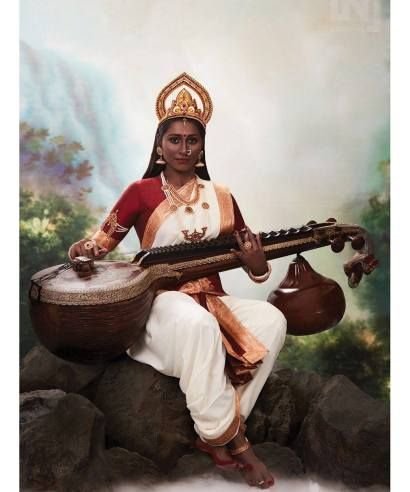
I wasn’t planning on writing this at all, but I was surprised to look at all the posts I have written so far and realise I have NONE about Saraswathy Poojai. This post is brought to you by my triggered feelings when I saw a debate on whether Saraswathy should be depicted as fair-skinned or dark-skinned earlier today, and I thought, “Are we still doing this? And for HER of all people?”
Unrestricted access to knowledge and information seems to have done little beyond fortifying echo chambers and a sense of “Only I am right.” I mean, colourism is not new, and it seems only natural that colourism, and its associated elitism, is preserved in arguments about Gods. So obviously, Gods can only be fair-skinned – are they supposed to look like the dark-skinned South Asian actresses in Hollywood? The blasphemy!!
And what better way to gatekeep actual knowledge and education, a potential leveller that can improve living conditions, opportunities, and resources, than to gatekeep access to the actual Goddess of Education? Going by the theory that Hinduism has so many Gods to allow for some sort of identification with the Gods, and thus worship, why would you even pray to the Goddess of Education when you don’t see yourself in her? Maybe then the gatekeeping of knowledge begins long before anyone even gets to a textbook – maybe it starts with who is allowed to pursue it in the first place, who can seek it, and ultimately, who gets to own it. Sidebar: Anthropic should be taking notes instead of spending precious time shredding books to scan them, in its pursuit of privatising knowledge.
Yes, I have heard arguments that Saraswathy’s white skin represents “fairness”, which is also why she is in a white saree and seated on a white lotus. Gods are not all depicted as white, though, considering Kali is black. But white, supposedly an indication of radiance or aura, has started to function as a complexion comparison chart instead. So, where do we draw the line between symbolism and reinforcing a social hierarchy that already privileges fair skin? I have actually come across a matrimonial profile that said, “We are looking for a bride who is fair at heart and skin”. It wasn’t the first or the only time I was reminded that symbolic whiteness and skin tones are treated interchangeably, or that the black Krishna was turned into blue in many depictions.
I mean, if it is truly about symbolism, why not make Her hair white too? Or would that compromise the aesthetic portrait of the Goddess – and of most Gods, for that matter, who are consistently depicted as ageless? We are in the era of generating Saraswathy Poojai wishes on ChatGPT after all, so why not ask it for white hair? Instead, we are outsourcing the act of thinking, creating and articulating – the very things that we are supposedly celebrating. Without even checking the generated image for cultural and linguistic accuracy at that!
Ironic, considering Saraswathy is often presented with a swan, which is believed to have the ability to separate milk from water when offered a mixture of the two in Hindu mythology; a metaphor for the pursuit of wisdom amidst the distractions of life, for discerning good from evil, truth from untruth, the milk from the mirages.
We pray to the Goddess of Culture, and we continue to police women as they are the torchbearers of culture. For the longest time, I thought it was a flex for the religion that education, knowledge, culture and the arts fell under the purview of a Goddess. I now look at the plague that is the incel culture, and wonder how different, if at all, things would be if we had a God of culture. Would men then be required to embody and perform certain ideals of culture, as women are? Or would the God of culture be dressed in pants and a shirt while the Goddess remains in a saree?
I'm not trying to be hypocritical; I do celebrate Saraswathy Poojai every year, particularly more so after I started thendraluthaman.com. It has become a way for me to express my gratitude for Her blessing me with the ability to articulate something in a way that resonates with someone else, and for the brains that led me to choose qualitative research over quantitative or mixed-methods research. Much of my celebration – for most festivals – centres on gratitude itself: having a dedicated day to thank the associated God for the element of life we are celebrating, rather than focusing on the mantras I should be chanting or the degree in which I should place and arrange my offerings on the altar.
And I would like to think that Saraswathy Herself would expect us to question these things rather than blindly follow them.
Yet arguments remain black and white, literally and figuratively.
Cover image credits: https://qz.com/india/1512700/facebook-photo-series-questions-indias-fair-skin-fetish